Scan a label. Get a score you can check.
Clem reads the label and scores the food 0–100 on five research-backed dimensions, then tells you whether it’s right for your diet, your allergens, and the things you’d rather avoid.

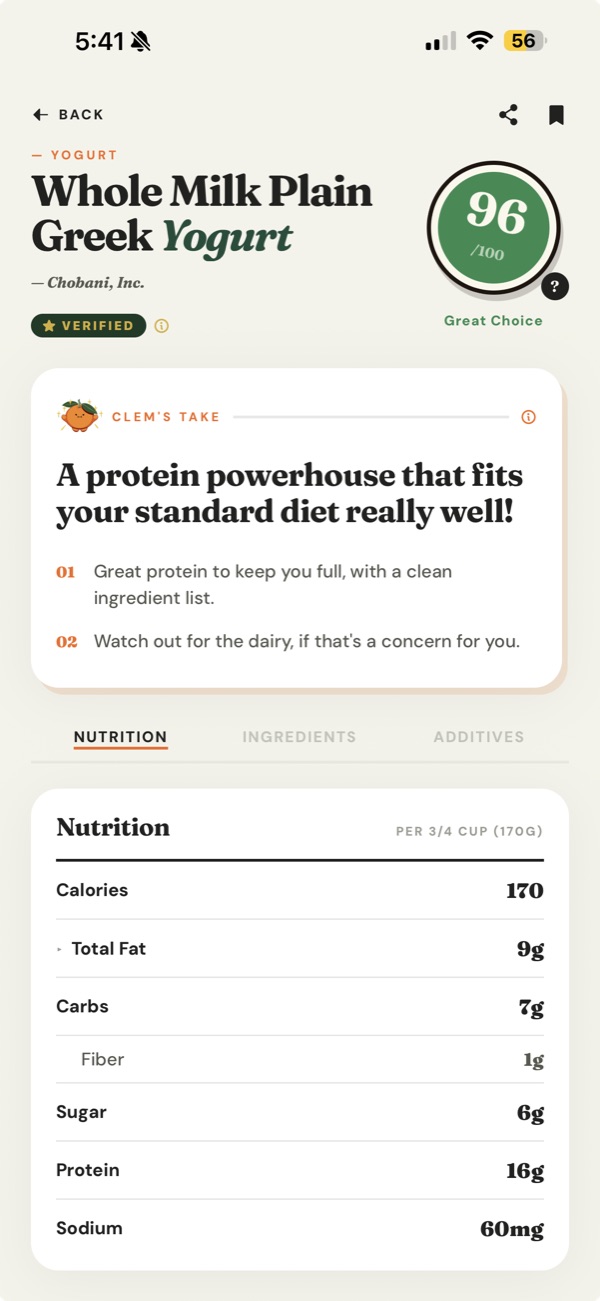
AI reads the label. Code computes the score.
The number isn’t an opinion. It’s a weighted formula over five dimensions, run on the label Clem just read. Scan the same product twice and you get the same score. So does everyone else.
Same food, same number.
What the code does
- Computes the 0–100 score from five weighted dimensions
- Grades each dimension A through F
- Applies the penalties and score caps
- Decides your green / yellow / red verdict from your profile
What the AI does
- Reads the product label out of your photo
- Writes Clem’s Take, the short editorial read
- Nothing else. It never touches the math
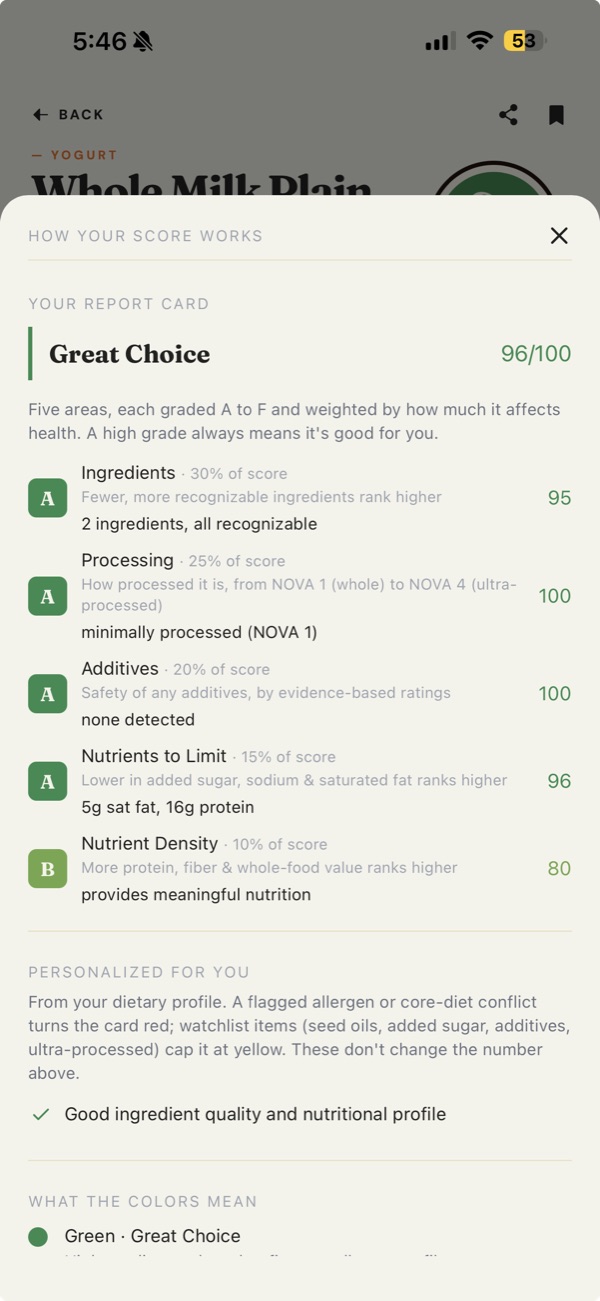
Five dimensions, each one graded.
Every scan shows all five as letter grades, so you can see exactly where a score came from. Nothing is hidden and nothing is weighted in secret.
| Dimension | Weight | What it measures | Grounded in |
|---|---|---|---|
| Ingredients | 30% | Fewer, more recognizable ingredients score higher; flagged ingredients pull it down. | Machado et al., 2021 |
| Processing | 25% | NOVA classification. Ultra-processed foods are linked to higher disease risk across 9.9M participants. | Lane et al., 2024 · BMJ |
| Additives | 20% | Each additive rated by safety tier, with the reason spelled out. | CSPI Chemical Cuisine |
| Nutrients to Limit | 15% | Sugar, sodium and saturated fat measured against public health thresholds. | WHO 2015 / AHA |
| Nutrient Density | 10% | Credit for foods that actually nourish: protein, fiber, and nutrient density. | ANDI nutrient-density framework |
Scroll the table sideways for what each dimension measures.
The label reading is done by Google Gemini. The arithmetic above is not.
One scale, four bands.
The same 0–100 scale for every product and every person. No curve, no category grading, no “healthy for a cookie.”
Excellent
“Excellent choice!”
Good
“Good pick!”
Fair
“Room to improve”
Poor
“Worth reconsidering”
The number rates the food. The verdict is about you.
Tell Clem your diet, your allergens, and what you’d rather avoid. The score stays exactly the same. What changes is the call Clem makes on it.
Diets: Standard, Keto, Paleo, Mediterranean, Vegan, Vegetarian. Allergen flags: gluten, dairy, tree nuts. Avoidances: seed oils, added sugars, additives, ultra-processed foods.
Green · Great Choice
High-quality product that fits your dietary profile.
Yellow · Worth a Look
Doesn’t fully fit your goals: maybe a diet mismatch, like carbs on keto, or something on your watchlist.
Red · Not For You
Contains a flagged allergen, or conflicts with your core diet. A red verdict overrides a high score.
Everything the label makes you work for.
One photo. Every one of these comes back, on the free plan too.
A transparent 0–100 score
With the full letter-grade report card behind it, dimension by dimension.
A personal verdict
Green, yellow or red, decided by your diet and your allergen flags.
Ingredients in plain language
The whole list, with the ones worth knowing about called out and explained.
Additives by safety tier
Each one rated and named, not just counted.
Seed oils and ultra-processing
Detected and flagged, whether or not you asked Clem to watch for them.
Full nutrition facts
Per serving, as printed, next to the thresholds Clem measured them against.
Healthier alternatives
Real products from the database that score better, not generic advice.
Clem’s Take
One short editorial read, written for your profile. The one place AI writes.
Set your profile
Diet, allergens, and the things you’d rather avoid. Two minutes, and you can change it any time.
Scan the label
Point the camera at the back of the pack. Clem reads it and runs the formula.
Decide, and keep it
Take the answer or take the swap. Save what’s worth buying again to your shelf.
No food is bad. Some is room to improve.
A score should be checkable. If we can’t show you the math, we haven’t earned the number.
A red verdict is information, not a verdict on you. Clem helps you decide; it doesn’t grade your character.
One scale for everyone. Personalization belongs in the advice, not in the arithmetic.
Fear is easy and useless. Clem is specific instead: this ingredient, this threshold, this better option.
Free covers the whole analysis.
Clem Pro lifts the limits. It doesn’t unlock the thinking. Every scan you take on the free plan is the complete one.
Free
No card needed- 10 scans a week
- 5 product searches a day
- The full 0–100 score and letter-grade report card
- Your personal green / yellow / red verdict
- Ingredients, additives, nutrition facts and Clem’s Take
- Your single best healthier swap
Clem Pro
7-day trial on annual- Unlimited scans, every week
- Every better pick — all swaps + browse
- Unlimited search, any product
The annual plan currently includes a 7-day free trial for eligible new subscribers. Eligibility is set by Apple. Subscriptions are billed through your Apple ID and renew automatically until you turn off auto-renew, at least 24 hours before the period ends. Manage or cancel any time in your Apple ID settings. Full subscription terms.
Personalized scoring is free. The score, the report card and the verdict are not Pro features. Pro raises the limits, not the quality of the answer.
Nothing here is for sale.
No ads
There is no ad slot in Clem, and no plan for one.
No ad trackers
No third-party advertising trackers in the app.
Your data isn’t sold
We don’t sell it. Read exactly what we keep in the privacy policy.
Location stays put
When it’s used for store distance it’s foreground-only, and the coordinates never leave your device.
Your groceries, minus the guesswork.
Scan the first thing in your cabinet and see what the formula says.